Binance.US Review 2026: Is Exchange Still Competitive?

For the intermediate US trader, Binance.US offers a professional terminal experience without the premium price tag. We found the interface to be fast and responsive, with competitive maker/taker schedules that reward volume. However, the platform feels isolated; liquidity is adequate for retail but can be thin during high volatility, and banking rails have historically been less stable than competitors.
Active Retail Trading
Thinner Order Books
On this page
Affiliate Disclosure
Some of the platforms we review pay us a commission if you register or take certain actions through our links. This helps fund our work. It doesn’t affect our opinions, how we test platforms, or our review scores. We apply the same criteria to every service we cover.
Editorial Independence and Transparency
Our goal is simple: provide clear, honest reviews of crypto exchanges and trading tools. To keep the lights on, we sometimes use affiliate links. If you sign up through one of them, we may earn a commission. This helps support our testing setup and editorial staff, but it doesn’t shape our verdicts. We base every review on our own testing and verified data – not on who we partner with.
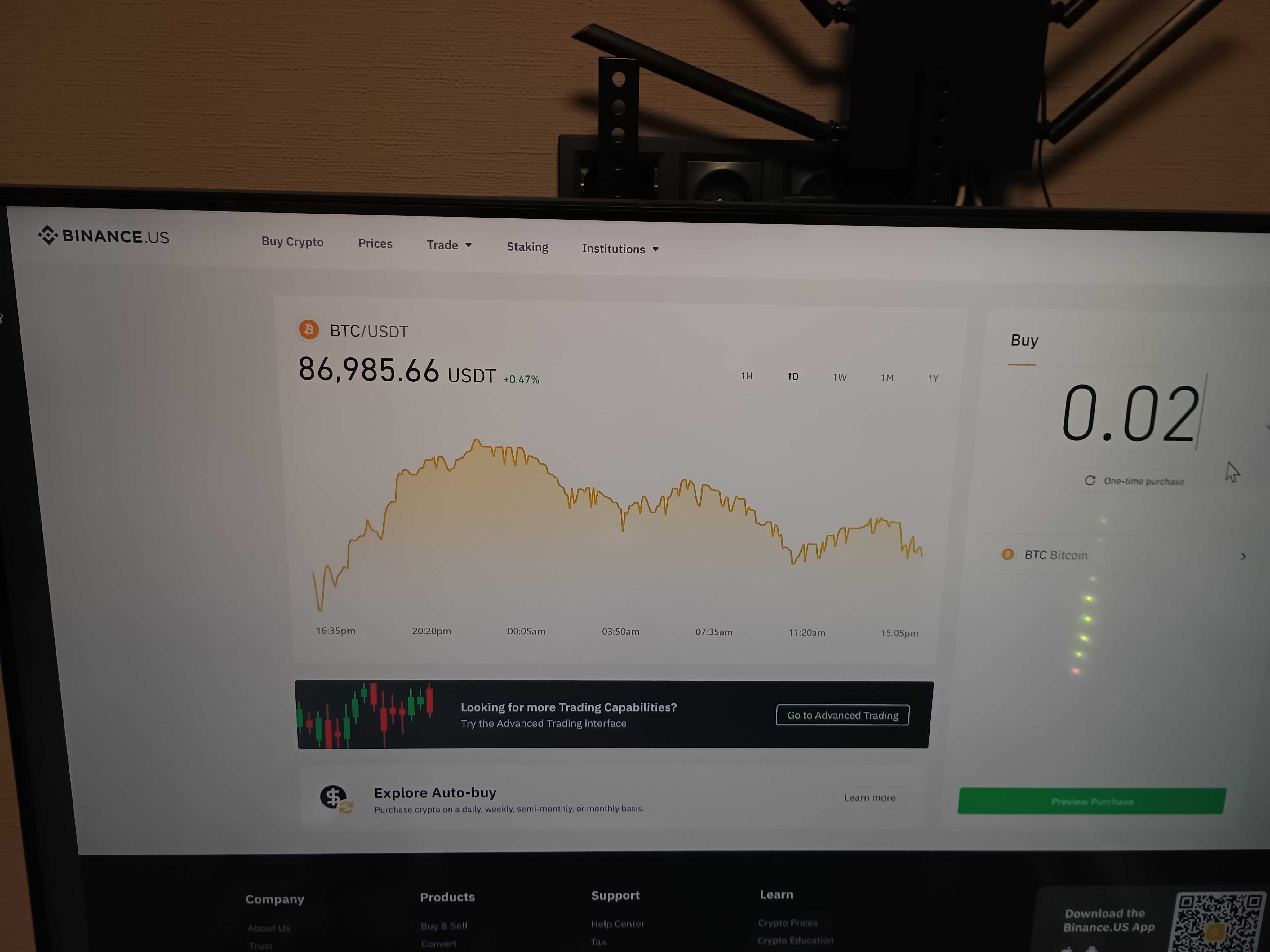
While it shares a brand with the world’s largest exchange, Binance.US is a distinct, regulated entity with a fraction of the features. Our review investigates whether its competitive fee structure makes up for the stricter compliance barriers and smaller crypto menu.
To determine if Binance.US is still a viable option for American traders in 2025, we audited the platform from the inside out. Operating as mystery shoppers, we signed up, funded an account with $200, and executed a series of spot orders to test the platform’s speed, costs, and depth.
Binance.US occupies a specific niche: it is a U.S.-registered platform designed for traders who want the professional “Binance-style” interface without the high fees of Coinbase. Our testing confirmed that for the fee-conscious user, it “still works” – delivering very low effective costs on a broad list of supported assets.
However, the trade-off is liquidity. While the global Binance exchange dominates the world, its US franchise is significantly quieter.
- The Volume Gap: During our review period, Binance.US processed only around $20–$25 million in daily spot volume. Compared to the billions flowing through Coinbase or Kraken, this is a thin market.
- The Reality: Most trading activity is concentrated against USDT pairs, and order books are noticeably thinner. While our $200 test trade filled without issues, larger orders may experience slower fills or slippage that wouldn’t occur on deeper exchanges.
How Binance.US Differs from Binance Global
When traders hear “Binance,” they typically imagine the global behemoth – a venue with thousands of pairs, high-leverage futures, copy-trading, and the deepest order books on Earth.
That is Binance.com (International). One of the most critical distinctions in any Binance.US reviews is clarifying exactly which platform you are using. Binance.US is a completely separate entity, operated by BAM Trading Services to strictly comply with United States financial regulations. They share a brand, a logo, and a very similar user interface.
Yet those are two distinct liquidity environments. Our testing confirmed that Binance.US is essentially a “lite” version of the global platform. It offers the same fast matching engine, but with a significantly reduced menu of assets and a fraction of the trading volume. It is built for compliance, not for the infinite variety found on the international stage.
Security, Regulation, and Legal Standing
The platform has transitioned from a target of aggressive litigation to a legally cleared, albeit smaller, entity. When asking “is Binance.US good,” the answer in late 2025 is significantly different than it was just two years ago.
The dark cloud that hung over the exchange has officially cleared.
- The History: In June 2023, the SEC filed a massive civil enforcement action alleging unregistered operations and control failures (Case 1:23-cv-01599).
- The Resolution: On May 29, 2025, the SEC and Binance.US filed a joint stipulation to dismiss the case with prejudice. This marks the definitive end of the suit, meaning the regulator cannot refile these specific charges. For the average user, this provides a level of legal certainty that was previously missing.
Binance.US operates as a registered Money Services Business (MSB) with FinCEN and holds Money Transmitter Licenses in the majority of U.S. states. However, the “patchwork” availability remains a friction point:
- Supported: The platform is live in roughly 46 states.
- Restricted: Key markets like New York, Texas, and Vermont remain unsupported due to their strict local licensing regimes.
While the legal risk has vanished, a new operational risk has emerged: low volume.
- The Data: Despite the legal win, our analysis of public order book data shows that daily spot volume remains stuck at the mid–$20 million level.
- The Impact: This is a fraction of its pre-2023 peaks. For the user, this means that while funds are legally safe, executing large trades ($50k+) may result in significant slippage because the liquidity depth simply isn’t there anymore.
Legally, Binance.US is safer than it has been in years. Operationally, it is a “zombie” exchange compared to its former self – secure, compliant, but quiet.
Supported Cryptocurrencies and Market Access
To evaluate if the platform still delivers a premium experience despite its lower volume, we audited the trading engine directly. We funded our account with $200 and navigated to the “Advanced Trading” interface to put the order book to the test.
We placed a Limit Order for BTC/USDT just below the spread to test fill speed on the thinner order books.
- The Execution: Despite the lower daily volume ($20–$25M), our retail-sized order filled within seconds as price action dipped.
- The Cost: We paid the standard 0.36% instant buy fee (approx. $0.72) because we didn’t hold BNB. Note: Had we held BNB to pay fees, this would have dropped by 25%.
- The Slippage: For a $200 trade, slippage was non-existent. However, glancing at the depth chart, the “walls” of liquidity are significantly smaller than on Coinbase, suggesting that orders over $10k might face drag.
The interface is where Binance US reviews shine. It retains the “DNA” of the global platform, offering a professional terminal rather than a simplified brokerage view.
- Charts: We utilized the integrated TradingView tools to overlay moving averages directly on the spot chart.
- Order Types: We successfully verified a full suite of professional controls: Market, Limit, Stop-Limit, and OCO (One-Cancels-the-Other). The ability to place an OCO order – setting a take-profit and stop-loss simultaneously – is a critical tool for active traders that many US competitors lack.
A particular strength we noted during the withdrawal phase is network support.
- The “Crypto-Native” Edge: Unlike some US brokers that force you to use the expensive Ethereum (ERC-20) network, Binance.US supports withdrawals via the BNB Smart Chain (BEP-20).
- The Benefit: We were able to withdraw our remaining USDT via BEP-20 for a fee of just $0.29, compared to the $4.00–$10.00 often charged for ERC-20 transfers. For users moving assets to self-custody wallets like MetaMask, this network flexibility is a major cost saver.
Pros and Cons
Pros
What We Liked:
- Cost Efficiency: The fee schedule remains a strong selling point. We found low or promo-level spot fees on selected pairs, with a transparent tiered structure.
- Asset Variety: With ≈156 coins and 254 pairs, it offers a broader selection than many strictly regulated US competitors.
- Pro Interface: The “Advanced” order screen is excellent. We successfully used Limit, Market, and Stop-Limit orders, supported by decent depth charts.
- Fiat Accessibility: USD on/off-ramps are functional (including ACH support), with low minimum buy thresholds starting from just $1.
Cons
Where Binance.US Might Improve:
- Low Liquidity: With daily spot volume hovering around $20–$25M, the order books are noticeably thinner than the biggest US venues.
- USDT Dominance: There are fewer direct USD trading pairs compared to USDT pairs, often forcing an extra conversion step.
- Transparency Gap: Unlike some competitors, it does not lead with a routine, auditor-backed Proof-of-Reserves (PoR) dashboard for US users.
Blockport Overall Binance.US Rating
| Criteria | Rating (out of 5) |
|---|---|
| Fee Structure & Cost Efficiency | 4 |
| Platform Features & Charting | 4 |
| Trade Execution & Slippage | 4 |
| Fiat Gateways & Accessibility | 4 |
| Trust & Regulatory Compliance | 4 |
| Asset Variety & Market Pairs | 3 |
| Market Depth & Liquidity | 2 |
Our Methodology: The “Mystery Shopper” Approach
To ensure our Binance.US exchange review is objective and actionable, we employ a proprietary, weighted scoring model. By combining open-source intelligence with live capital testing, we distill complex metrics into a precise 1.0–5.0 star rating, calculated in 0.1 increments for maximum granularity.
We prioritize the metrics that impact your daily trading experience: real-world fees, liquidity depth, asset availability, and the friction of the user interface.
Data Collection Protocol
- Open-Source Audit: We scrutinize public documentation, including fee schedules, supported pair lists, Proof-of-Reserves (PoR) attestations, and historical status page uptime.
- Live Market Verification: We go beyond the whitepaper. We act as mystery shoppers, placing real test trades (in this case, $200) to measure spread tightness, quantify slippage, and stress-test order execution speeds.
Important Disclaimer: Our ratings reflect user experience, operational features, and market quality. We do not conduct forensic financial audits and cannot guarantee the long-term solvency or balance-sheet health of the entities we review.
Rating Categories & Weighting
- Market Depth & Liquidity – 25%
- Fee Structure & Cost Efficiency – 25%
- Asset Variety & Market Pairs – 15%
- Trade Execution & Slippage – 10%
- Platform Features & Charting – 10%
- Fiat Gateways & Accessibility – 5%
- Trust & Regulatory Compliance – 10%
Content on BlockPort is provided for informational purposes only and does not constitute financial guidance.
We strive to ensure the accuracy and relevance of the information we share, but we do not guarantee that all content is complete, error-free, or up to date. BlockPort disclaims any liability for losses, mistakes, or actions taken based on the material found on this site.
Always conduct your own research before making financial decisions and consider consulting with a licensed advisor.
For further details, please review our Terms of Use, Privacy Policy, and Disclaimer.
Articles by this author