What Is MoonPay? A Practical Overview of How the Service Works

MoonPay is a global crypto payments provider built for fast and simple fiat-to-crypto purchases rather than full trading. It lets users buy and sell digital assets using familiar payment methods such as bank cards, bank transfers, Apple Pay, and Google Pay, with purchased crypto delivered straight to a personal wallet. Its strengths are ease of use, broad payment support, and strong regulatory compliance. The trade-off is cost: convenience fees and variable spreads make transactions noticeably more expensive than exchange-based on-ramps.
quick fiat-to-crypto purchases
higher fees compared to exchanges
On this page
- What Is MoonPay and How It Works
- Fees and Exchange Rates
- Using MoonPay: Interface, Speed, and Customer Support
- Security, Compliance, and Reputation
- Strengths, Drawbacks, and Our Final Take
- Blockport’s Comprehensive MoonPay Rating
- MoonPay Review Criteria: How We Score Performance
- How We Source and Validate Our Findings
- Rating Categories and Weight Allocation
Affiliate Disclosure
Some of the platforms we review pay us a commission if you register or take certain actions through our links. This helps fund our work. It doesn’t affect our opinions, how we test platforms, or our review scores. We apply the same criteria to every service we cover.
Editorial Independence and Transparency
Our goal is simple: provide clear, honest reviews of crypto exchanges and trading tools. To keep the lights on, we sometimes use affiliate links. If you sign up through one of them, we may earn a commission.
This helps support our testing setup and editorial staff, but it doesn’t shape our verdicts. We base every review on our own testing and verified data – not on who we partner with.

MoonPay is a fast fiat-to-crypto service that lets users buy and sell digital assets using cards, bank transfers, Apple Pay, and Google Pay. It focuses on simplicity and compliance rather than full-scale trading, with crypto delivered directly to external wallets.
To evaluate MoonPay accurately, we went through the full process ourselves: we created an account, completed verification, added a payment method, and ran multiple buy and sell transactions to measure real fees, delivery times, and overall reliability. This hands-on approach showed how MoonPay works in practice as a fast, compliance-focused fiat-to-crypto gateway.
Purchases were delivered directly to external wallets, verification steps were strict but consistent, and payment processing functioned smoothly across supported methods. Our findings reflect the platform as it operates for everyday users, not how it appears in promotional materials.
What Is MoonPay and How It Works
Founded in 2019, MoonPay is a crypto fintech platform that offers a straightforward way to buy and sell digital assets using familiar payment methods. Rather than operating as a full cryptocurrency exchange, MoonPay functions as a fiat-to-crypto gateway: users can purchase assets such as BTC, ETH, USDT, and many others through bank cards, bank transfers, Apple Pay, Google Pay, and regional payment partners.
The service is built around fast, compliant onboarding. MoonPay manages identity verification, payment processing, fraud checks, and asset delivery. Once a transaction is approved, crypto is sent directly to a user’s external wallet or exchange account. For anyone asking what is Moon Pay in practical terms, it acts as a bridge between traditional banking rails and on-chain wallets, not a platform for active trading.
Beyond retail purchases, MoonPay has expanded into business-oriented infrastructure. The company now provides enterprise-grade stablecoin issuance tools, allowing businesses to create and redeem branded stablecoins for payments and settlement – a shift that moves MoonPay beyond a simple on-ramp toward a broader crypto payments provider.
MoonPay supports more than 100 assets and integrates with major wallets and Web3 applications including Ledger, MetaMask, Trust Wallet, Phantom, and a wide range of DeFi and NFT platforms. Some integrations extend beyond basic purchases: MoonPay powers fiat deposits and withdrawals for multiple Web3 services, including implementations that streamlined on- and off-ramping on Uniswap.
The platform also offers crypto-to-fiat off-ramping in supported regions, enabling users to convert digital assets back to traditional currency and withdraw funds to a bank account. Combined with broad payment coverage, direct wallet delivery, and expanding infrastructure tools, MoonPay plays a growing role in the wider crypto ecosystem.
Fees and Exchange Rates
MoonPay’s pricing is built around convenience: fast payments, broad coverage, and simple onboarding. The trade-off is cost. For users wondering is MoonPay trustworthy, its fees are transparent, but they are not the lowest on the market.
- Buy Fees (Card, Apple Pay, Google Pay, Transfers). MoonPay charges a percentage fee plus a network spread. Card payments typically cost around 4.5%, though the rate may vary by region and payment provider. Apple Pay and Google Pay fall within a similar range. Bank transfers, where supported, are usually cheaper at approximately 1%, making them the most cost-efficient on-ramp option.
- Sell / Off-Ramp Fees. Converting crypto back to fiat generally incurs a 1% fee, excluding any charges your bank may apply. Processing times depend on the user’s region and local banking networks.
- Network And Gas Fees. Every purchase includes a blockchain network fee based on the asset and current chain congestion. MoonPay passes this fee directly to the user and displays it before the transaction is confirmed.
- Exchange Rate Spread. MoonPay also applies a spread to the displayed asset price. The exact amount varies with market volatility, but during our testing the spread generally fell in the 1%–3% range.
- Availability And Limits. Limits depend on region, payment method, and verification level. Fully verified users in supported countries can typically purchase several thousand dollars’ worth of crypto per day, with higher limits available after enhanced checks.
MoonPay prioritizes speed, reliability, and broad payment support rather than the lowest possible fees. It remains a trustworthy option for users who want a fast, compliant way to move between fiat and crypto, though cost-sensitive buyers may find cheaper rates on exchange-based on-ramps.
Using MoonPay: Interface, Speed, and Customer Support
MoonPay is built for quick, task-focused transactions rather than full trading, and the experience reflects that. The interface is clean and minimal: you choose an asset, enter an amount, select a payment method, and confirm. In our testing, the flow from payment to delivery was straightforward, and purchased crypto arrived in external wallets within minutes once verification was complete.
The platform is intentionally simple. There is no order book, charting, or advanced settings – only a guided buy or sell flow. This makes MoonPay accessible to newcomers who want a fast way to purchase crypto without navigating an exchange-style interface.
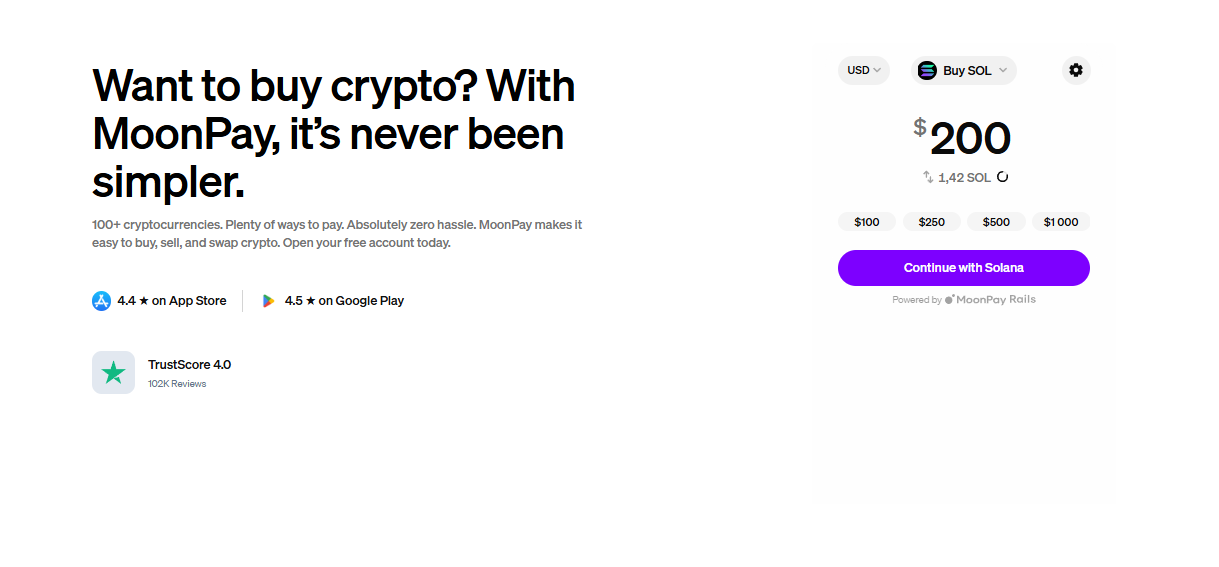
KYC steps are strict but predictable. After the initial check is completed, future purchases require only payment approval. Card transactions processed almost instantly in our tests, while bank transfers took longer depending on the provider and region.
Support is handled mainly through email and a help center. Response times vary: general issues tend to be resolved quickly, while payment or compliance reviews can take longer, especially when extra documentation is required. This is typical for regulated payment processors, but it does mean transactions may be delayed if they trigger additional checks.
Security, Compliance, and Reputation
MoonPay operates as a regulated payment processor rather than a traditional crypto exchange, which shapes how it handles security and compliance. The company is registered as a Money Services Business (MSB) with FinCEN in the United States and holds virtual-asset or payment-service approvals in multiple regions across the UK, EU, and Asia-Pacific. This regulatory foundation is a key part of how the platform positions itself within MoonPay reviews.
MoonPay does not custody user funds: purchased assets are delivered directly to a user’s wallet or exchange account, reducing exposure to centralized storage risks. Sensitive data is encrypted, payment details are tokenized, and transactions pass through fraud-prevention systems designed to flag chargebacks, stolen cards, and unusual activity. Identity verification and two-factor authentication add another layer of protection, particularly for high-value purchases.
Because MoonPay processes real financial data, its compliance standards are strict. The platform conducts full KYC/AML checks, works with licensed banking partners, and follows PCI DSS requirements for handling card information. These safeguards reduce fraud but can slow down transactions when additional verification is required.
Recent developments reflect MoonPay’s push to reinforce its infrastructure. In late 2025, Galaxy Digital supplied $200 million in liquidity, increasing the company’s capacity to support higher volumes and institutional-level payment flows. At the same time, like other regulated payment processors, MoonPay has faced occasional reputational challenges: a widely reported incident involved senior executives falling victim to a social-engineering scam, highlighting that fraud risks can affect companies as well as end users.
Strengths, Drawbacks, and Our Final Take
MoonPay is built for speed and simplicity, offering one of the most accessible ways to move between fiat and crypto. It isn’t designed for active trading or low-cost execution, but for users who value convenience and reliable payment processing, its strengths are clear.
Pros
What we liked:
- Ease of use: A clean, minimal interface that lets users complete a purchase in minutes without navigating exchange-style tools.
- Wide payment support: Cards, bank transfers, Apple Pay, Google Pay, and regional providers make crypto purchases broadly accessible.
- Strong compliance: Registered as an MSB with FinCEN and operating under strict KYC/AML rules, offering more regulatory clarity than most on-ramps.
- No custodial risk: Crypto is delivered directly to an external wallet, reducing exposure to centralized storage failures.
Cons
Where MoonPay might fall short:
- High convenience fees: Card payments and variable spreads make purchases noticeably more expensive than exchange-based alternatives.
- Verification slowdowns: Compliance checks can delay transactions, especially for larger amounts or flagged payment methods.
- Limited functionality: No trading tools, no order types, and no ability to store or manage assets on the platform.
- Customer support delays: Email-based support can take time to resolve payment or identity-related issues.
After testing the full process – from account creation to completing live transactions – our verdict is clear: MoonPay excels as a fast, straightforward fiat-to-crypto gateway. It offers a polished flow, wide payment coverage, and strong regulatory safeguards, making it a solid choice for users who want a reliable way to buy crypto without navigating complex exchange interfaces.
Whether it’s “worth it” depends on your priorities.
- If speed, simplicity, and regulatory transparency matter most, MoonPay is a strong fit.
- If low fees or advanced trading features are the priority, a traditional exchange will offer better value.
MoonPay delivers a smooth, beginner-friendly experience with predictable performance – just be prepared to pay a premium for the convenience.
Blockport’s Comprehensive MoonPay Rating
| Criteria | Rating (out of 5) |
|---|---|
| Market Depth & Liquidity | 3 |
| Fiat Gateways & Accessibility | 5 |
| Asset Variety & Market Pairs | 4 |
| Trade Execution & Slippage | 4 |
| Platform Features & Charting | 2.5 |
| Trust & Regulatory Compliance | 4.5 |
| Fee Structure & Cost Efficiency | 3 |
MoonPay Review Criteria: How We Score Performance
To keep every score consistent and objective, we use a structured, category-based evaluation model. Each rating combines our review of official documentation with hands-on testing using a live account. This approach allows us to assign a precise 1.0 to 5.0 score, calculated in 0.1-point increments for accuracy.
How We Source and Validate Our Findings
- Platform Documentation Review: We analyze MoonPay’s official materials, including fee disclosures, supported payment methods, system status updates, and regulatory filings to verify how the service is designed to operate.
- Live Purchase and Withdrawal Tests: We run real transactions through a verified account to measure actual fees, delivery times, payment friction, and how the platform handles verification steps during normal use.
Our ratings focus on user experience, reliability, and operational quality. We do not assess MoonPay’s corporate solvency or make predictions about its long-term financial stability.
Rating Categories and Weight Allocation
- Fee Structure & Cost Efficiency – 35%
- Payment Methods & Accessibility – 25%
- Reliability & Transaction Speed – 15%
- Asset Availability – 10%
- Security Standards & Compliance – 10%
- User Experience & Support – 5%
Content on BlockPort is provided for informational purposes only and does not constitute financial guidance.
We strive to ensure the accuracy and relevance of the information we share, but we do not guarantee that all content is complete, error-free, or up to date. BlockPort disclaims any liability for losses, mistakes, or actions taken based on the material found on this site.
Always conduct your own research before making financial decisions and consider consulting with a licensed advisor.
For further details, please review our Terms of Use, Privacy Policy, and Disclaimer.
Articles by this author