
Binance Review 2026: Trading, Tools, and Real Execution Quality

Binance is the world’s largest crypto exchange by trading volume, offering more than 350 assets and over 1,300 spot pairs with deep liquidity on major markets like BTC, ETH, and SOL. Base trading fees start at 0.10% and fall to 0.075% when paid with BNB, with VIP tiers driving costs even lower for high-volume accounts. The Pro interface provides advanced charts and a full range of order types, while Lite mode keeps basic trading straightforward.
active spot traders
regional limits and complexity
On this page
Affiliate Disclosure
Some of the platforms we review pay us a commission if you register or take certain actions through our links. This helps fund our work. It doesn’t affect our opinions, how we test platforms, or our review scores. We apply the same criteria to every service we cover.
Editorial Independence and Transparency
Our goal is simple: provide clear, honest reviews of crypto exchanges and trading tools. To keep the lights on, we sometimes use affiliate links. If you sign up through one of them, we may earn a commission.
This helps support our testing setup and editorial staff, but it doesn’t shape our verdicts. We base every review on our own testing and verified data – not on who we partner with.
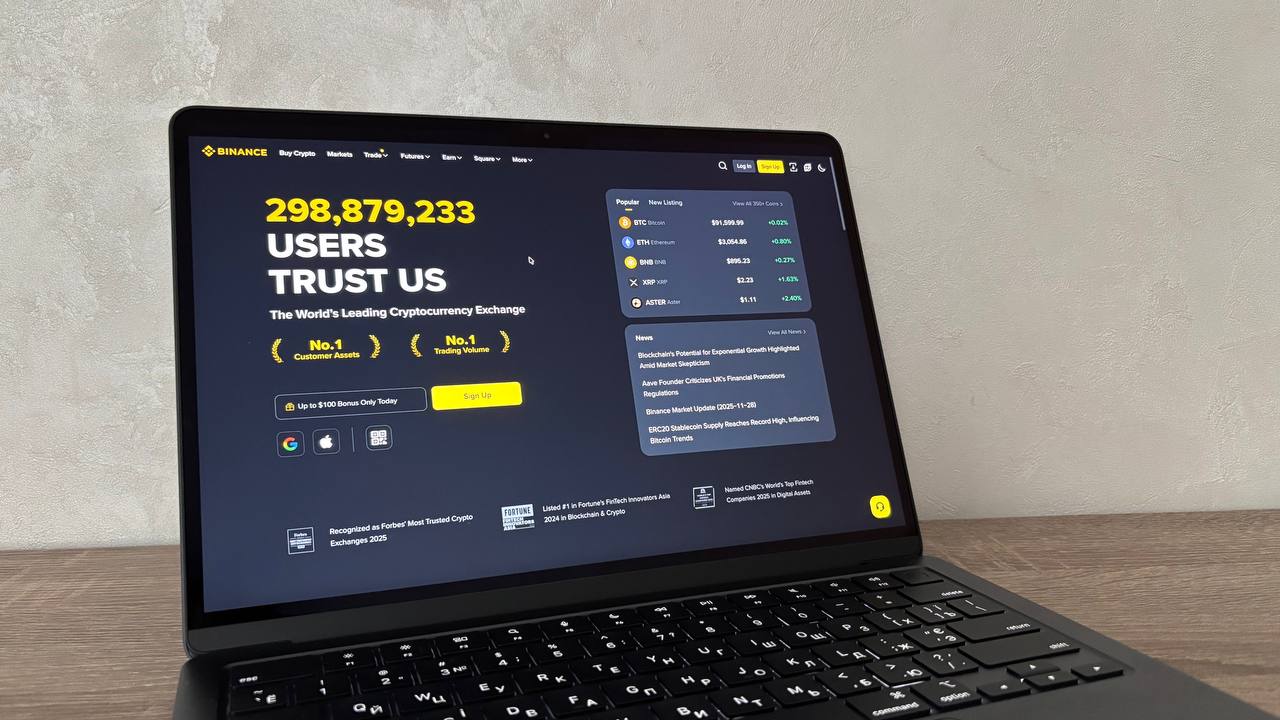
Binance remains the largest crypto exchange by trading volume, offering deep liquidity, low fees, and over 1,300 spot pairs. We tested the platform end-to-end to see how it performs for real traders.
To evaluate the platform from a real user’s perspective, we created an account, completed verification, added funds, and placed several spot trades to see how Binance performs in practice. The process confirmed why it leads the global market: onboarding is quick, verification moves fast, and both the mobile and desktop interfaces shift smoothly from basic to advanced tools. Orders filled instantly thanks to deep liquidity and the broad list of supported assets made testing multiple pairs simple.
What Is Binance?
Founded in 2017 by Changpeng Zhao and Yi He, Binance has grown into the world’s largest cryptocurrency exchange by trading volume, serving tens of millions of users in more than 180 countries. Its rise was rapid: within six months, it became a global leader, and today it processes more spot trades than any other centralized platform, offering more than 350 assets and over 1,300 spot pairs.
For many traders, Binance functions as a full-stack crypto hub, with a liquid spot market, base fees starting at 0.10%, optional BNB fee discounts, and a mobile app that shifts between Lite and Pro modes depending on experience. Deep liquidity on major pairs like BTC, ETH, and SOL helps limit slippage and improves order execution.
The exchange now operates under stricter compliance oversight following regulatory actions in several regions. Even so, Binance remains the leading venue for active spot traders who value liquidity, market depth, and competitive pricing – a point often highlighted in Binance reviews.
Fees, Limits, and VIP Levels
Binance structures its fees for efficiency: low base rates, straightforward discounts, and consistent execution. For anyone asking is Binance good from a cost perspective, the answer depends on how often you trade and whether you use BNB for fee reductions.
Base spot fees start at 0.10% for maker and taker orders. Paying with BNB lowers that by 25%, bringing the effective rate to 0.075% – one of the most competitive entry tiers among major exchanges. High-volume traders can cut costs further through the VIP program, where fees drop as 30-day volume and BNB balance increase. At the top levels, rates fall to 0.00825% maker and 0.01725% taker.
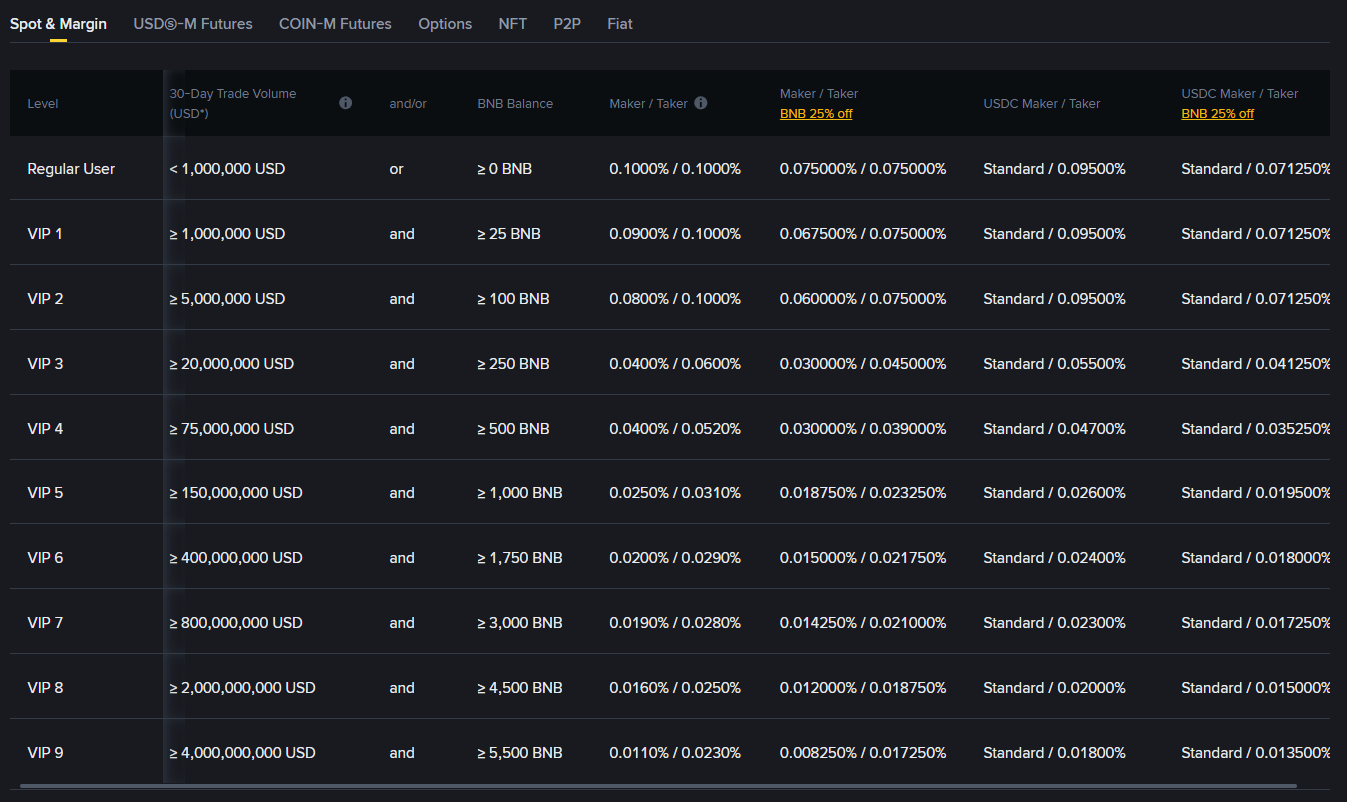
Crypto deposits are free. Withdrawal fees vary by network and change with blockchain conditions. Fiat deposit and withdrawal costs depend on currency and payment method; bank transfers are usually the lowest-cost option, while card payments carry higher fees.
The system clearly favors active traders. Higher volume and larger BNB holdings unlock deeper discounts, giving frequent spot traders and algorithmic desks more predictable, lower execution costs.
For newcomers, the default fees are already low. For professionals, the VIP tiers make Binance one of the most cost-efficient global venues. Combined with deep liquidity on major pairs, this pricing model is a major factor behind Binance’s appeal to high-volume spot traders.
User Interface and Support Services
Binance offers a flexible trading environment suited to both beginners and advanced users. The platform divides its interface into two modes, each designed for a different level of experience.
- Binance Lite: a simplified view focused on basic buy-and-sell actions. It removes advanced charts and order types, making it easy for newcomers to complete verification, fund their accounts, and place their first trades without navigating a full terminal.
- Binance Pro: a full trading workspace with depth charts, advanced order types (limit, stop-limit, stop-market, OCO), and more than 1,300 spot pairs. Liquidity on major assets like BTC, ETH, and SOL supports fast execution, and the interface gives active traders the precision they need.
Customer support is functional but remains one of Binance’s weaker points. Most users rely on live chat, which often starts with automated prompts before connecting to a real agent. Response times have improved, but the experience varies by region, and phone support is not offered.
Security features on mobile and desktop, such as 2FA, device management, address allowlisting, and malicious contract detection, fit smoothly into the user flow, making account protection straightforward without slowing users down.
Pros, Cons, and Final Verdict
This Binance exchange review shows a platform built for traders who value liquidity, tight spreads, and low fees. It has shortcomings, but its strengths are most visible in the spot market.
Pros
What we liked about Binance
- Strong liquidity: deep books on BTC, ETH, SOL, and other majors keep spreads tight and orders filling quickly, even at larger sizes.
- Low trading costs: a 0.10% base rate, 25% BNB discount, and VIP tiers for high-volume accounts make Binance one of the most cost-efficient major exchanges.
- Flexible interface: Lite mode works well for beginners, while Pro mode offers advanced charts, order types, and full market depth.
- Large asset list: more than 350 coins and over 1,300 spot pairs give traders wide market coverage.
- Security options: two-factor authentication, withdrawal allowlists, device controls, Proof-of-Reserves data, and the SAFU fund form a layered security system.
Cons
Where Binance might improve
- Regulatory limits: availability and product access vary by region, with stricter rules in some markets.
- Steep learning curve: the Pro interface can feel crowded until new users get used to it.
- Reputation concerns: past enforcement actions continue to influence how some traders view the platform.
After testing the entire flow – from onboarding to live spot execution – the conclusion is clear: Binance delivers the liquidity, pricing, and tools that active traders need. For large spot orders, its combination of execution quality and low fees is hard to match.
Whether it’s the right choice depends on your priorities. If you want a simple interface and strong regulatory oversight, other platforms may feel more comfortable. But if your focus is low-cost trading and access to global liquidity, Binance remains one of the strongest options on the market.
Binance Overall Blockport Rating
| Criteria | Rating (out of 5) |
|---|---|
| Market Depth & Liquidity | 5 |
| Fiat Gateways & Accessibility | 4 |
| Asset Variety & Market Pairs | 5 |
| Trade Execution & Slippage | 5 |
| Platform Features & Charting | 4 |
| Trust & Regulatory Compliance | 3 |
| Fee Structure & Cost Efficiency | 3 |
Our Review Framework: How We Rate
To ensure consistency across all evaluations, we use a structured scoring system. Each rating combines independent research with hands-on platform testing to produce a final score on a 1.0–5.0 scale with 0.1-point precision.
How We Collect and Verify Data
- Platform and documentation analysis: we review Binance’s public materials, including fee tables, asset listings, system status logs, regulatory disclosures, and security documents, to verify how the platform functions in practice.
- Live market testing: we execute real trades to assess spreads, slippage, order execution, and overall platform friction. Testing in live conditions shows how Binance performs beyond its advertised claims.
Our scores reflect user experience, feature depth, and platform performance. We do not evaluate corporate solvency or make predictions about long-term financial stability.
Categories & Weights
- Liquidity & Volume – 25%
- Fees & Total Cost to Trade – 25%
- Asset Selection & Trading Pairs – 15%
- Execution Quality (Market Quality) – 10%
- Tools & Order Controls – 10%
- Fiat Access & Minimum Trade Size – 5%
- Reliability & Transparency – 10%
De inhoud op BlockPort wordt uitsluitend ter informatie aangeboden en vormt geen financieel advies.
We streven ernaar om de juistheid en relevantie van de informatie die we delen te waarborgen, maar we garanderen niet dat alle inhoud volledig, foutloos of up-to-date is. BlockPort wijst elke aansprakelijkheid af voor verliezen, fouten of acties die zijn ondernomen op basis van het materiaal op deze site.
Doe altijd uw eigen onderzoek voordat u financiële beslissingen neemt en overweeg om een erkende adviseur te raadplegen.
Raadpleeg voor meer informatie onze gebruiksvoorwaarden, ons Privacybeleid en onze Disclaimer.


