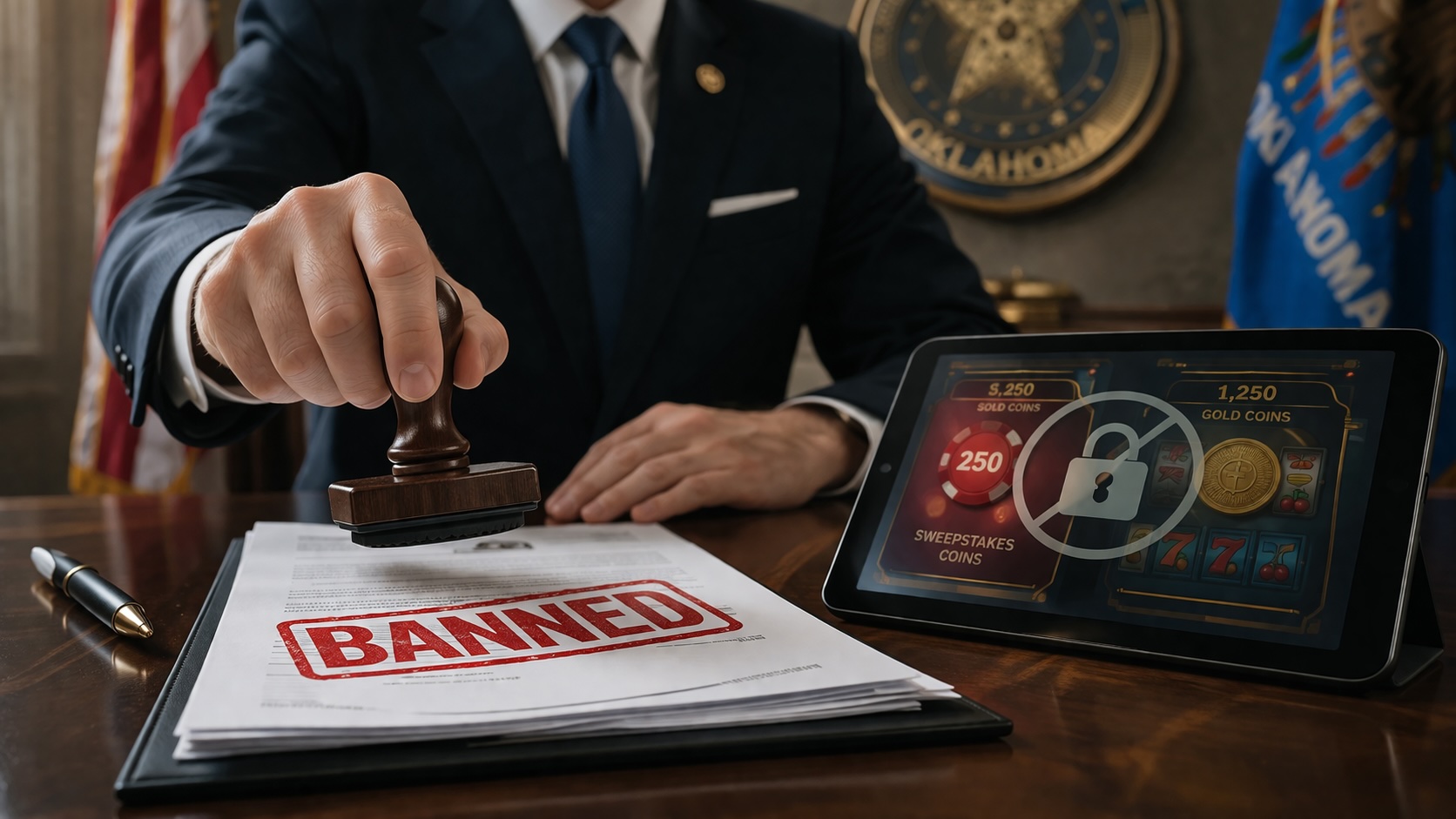
Iowa law lets regulators target unlicensed sweepstakes
Gov. Kim Reynolds signed SF 2289 granting the Iowa Racing and Gaming Commission authority to seek injunctions and cease-and-desist orders against unlicensed gambling, including ‘illegal sweepstakes’.
Gov. Kim Reynolds signed SF 2289 in May 2026, expanding the Iowa Racing and Gaming Commission’s authority to pursue unlicensed gambling operators. The Legislature approved the bill unanimously in April. The law allows the commission to seek cease-and-desist orders and injunctive relief against anyone offering games of chance, gambling, sports wagering or “illegal sweepstakes” in Iowa without a license or other legal authorization.
The measure inserts the term “illegal sweepstakes” into the state statute that governs the commission’s enforcement powers but does not define sweepstakes by payment model. It does not reference dual- or multi-currency payment systems, a feature commonly associated with internet-based sweepstakes platforms. The law also extends enforcement authority to unlicensed pari‑mutuel wagering, advance-deposit wagering and internet fantasy sports contests.
Under the statute, regulators can order operators to stop offering unlicensed games and can seek court-ordered relief to halt activity within Iowa. The law strengthens civil enforcement remedies; it does not create new criminal penalties or include provisions to require disgorgement of profits tied to illegal operations.
Iowa’s approach contrasts with states that enacted explicit bans aimed at sweepstakes platforms that use dual-currency systems. In 2025, Indiana, Maine and Oklahoma passed laws that define and prohibit online sweepstakes games that simulate casino-style play and use dual- or multi-currency payment models. Legislatures in Tennessee and Louisiana sent similar bills to their governors in 2026.
Nevada adopted an enforcement package in 2025 that expanded regulators’ powers and required disgorgement of profits from illegal gaming. After that law took effect, most sweepstakes casinos operating there exited the market. Iowa’s statute does not include disgorgement, but it gives regulators clearer civil authority to act against operators they consider unlicensed.
Attempts to pass either direct prohibitions or broader enforcement measures failed this year in Florida, Maryland, Minnesota, Mississippi, Massachusetts and Virginia. Supporters of SF 2289 told lawmakers regulators previously lacked a clear statutory basis to pursue operators they viewed as running unlicensed gambling services.
The law takes effect amid rising scrutiny of internet-based gambling products at state and federal levels. Regulators in Iowa can now use civil remedies to try to halt unlicensed activity while other states continue to adopt varying legal approaches to sweepstakes-style platforms.
Content on BlockPort is provided for informational purposes only and does not constitute financial guidance.
We strive to ensure the accuracy and relevance of the information we share, but we do not guarantee that all content is complete, error-free, or up to date. BlockPort disclaims any liability for losses, mistakes, or actions taken based on the material found on this site.
Always conduct your own research before making financial decisions and consider consulting with a licensed advisor.
For further details, please review our Terms of Use, Privacy Policy, and Disclaimer.
Articles by this author