House Democrats Seek Subpoenas Over Polymarket, Kalshi Trades
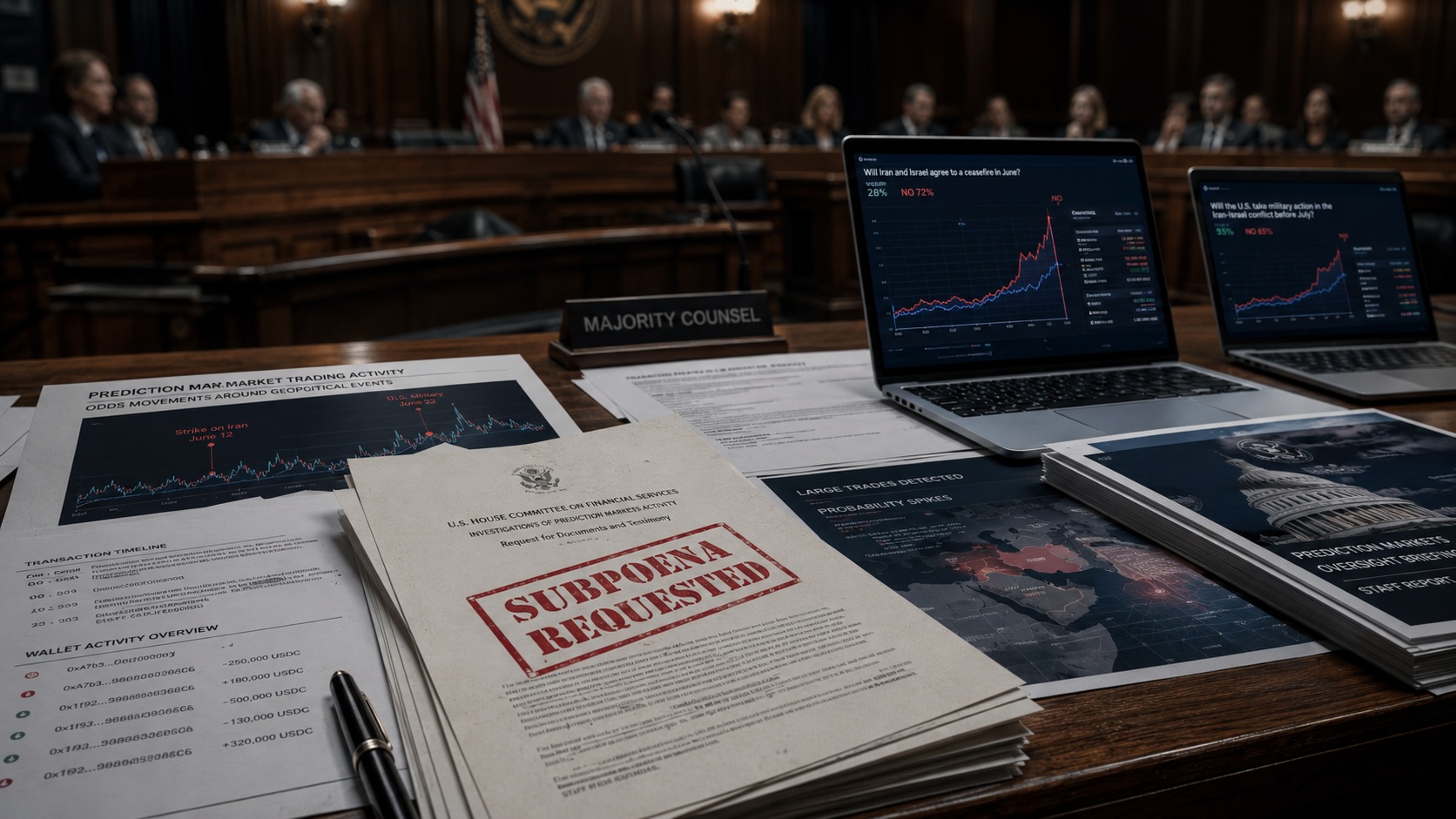
Seven House Democrats asked Oversight Chair James Comer for subpoena power to probe timed bets on Polymarket and Kalshi tied to U.S. and Israeli strikes and a U.S.-Iran ceasefire.
Seven House Democrats on Monday asked House Oversight Chair James Comer to issue subpoenas to investigate timed bets on prediction platforms Polymarket and Kalshi that appear linked to unannounced U.S. and Israeli strikes and to a sudden U.S.-Iran ceasefire. The letter requests authority to obtain trading records, account information and internal compliance logs to determine whether nonpublic information was used to profit from those events.
The lawmakers cited a March report that identified a single trader who earned nearly $1 million with a 93% success rate on wagers predicting strikes that were not public at the time. Those wagers were placed hours before operations in October 2024, June 2025 and February 2026. The letter also highlights a group of 38 accounts that reportedly netted more than $2 million on strikes on February 28 after being funded the week before.
The Democrats raised concerns about a cluster of at least 50 newly created accounts that placed coordinated bets on a U.S.-Iran ceasefire on April 7, with some accounts opened minutes before the public announcement. The letter connects these trading patterns to the risk that prediction markets can be misused when insiders hold nonpublic government or military information.
The request references recent criminal cases. U.S. Army Master Sgt. Gannon Van Dyke was arrested and charged with using classified information about a separate operation to place bets on a prediction platform. Israeli authorities have charged two people, including a military reservist, with allegedly using classified intelligence to make Iran-related wagers. The Democrats described those prosecutions as an example of how insider information can enter these markets.
The letter singles out Polymarket Global, the offshore arm of Polymarket, saying its access controls appear bypassable by virtual private networks and that identity checks do not reliably block U.S. users. Kalshi is identified as a designated contract market regulated by the Commodity Futures Trading Commission and requires identity verification. The lawmakers noted that Kalshi suspended and fined three political candidates earlier this year for trading related to their campaigns.
Polymarket previously agreed to a consent order that required it to geoblock American users; the company later partially lifted that restriction while seeking full U.S. licensure. The Democrats asked Comer to outline the Oversight Committee’s intended approach by May 22 and urged the committee to use its subpoena power if voluntary cooperation and platform self-policing prove insufficient.
Congress has moved on related fronts: the Senate approved a ban on senators trading in prediction markets, the White House warned staff against using nonpublic information in financial bets, and several bipartisan bills introduced since March would criminalize insider trading on prediction markets or impose stricter oversight. If subpoenas are issued, platforms could be required to turn over trading data and account records that would show who profited and whether accounts were coordinated. The prediction market industry spent about $975,000 on federal lobbying in 2025. It remains unclear whether Comer will act on the Democrats’ request.
Content on BlockPort is provided for informational purposes only and does not constitute financial guidance.
We strive to ensure the accuracy and relevance of the information we share, but we do not guarantee that all content is complete, error-free, or up to date. BlockPort disclaims any liability for losses, mistakes, or actions taken based on the material found on this site.
Always conduct your own research before making financial decisions and consider consulting with a licensed advisor.
For further details, please review our Terms of Use, Privacy Policy, and Disclaimer.
Tags
Articles by this author